
A loose screw on an outlet terminal or a cable that a nail nicked years ago can spark inside your wall without ever tripping a standard breaker. An arc fault breaker is designed to detect that sparking and shut the circuit off before it can start a fire. That protection isn’t required on every circuit, though. Whether a circuit in your Whittier home needs it depends on the room it serves, when the house was wired, and whether new electrical work is planned. Understanding these requirements can help you determine whether your home has the protection it needs.
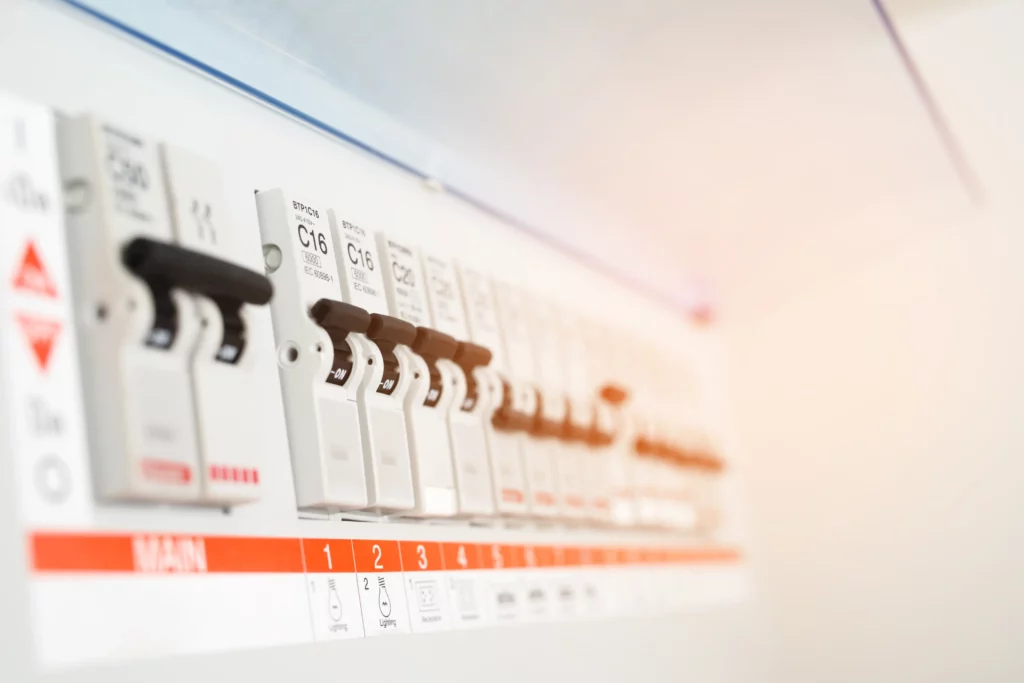
Which Rooms Need Arc Fault Protection?
Arc fault protection is required on the everyday 120-volt, 15- and 20-amp circuits that power the rooms where you live, sleep, cook, and do laundry. That rule comes from the 2023 National Electrical Code (NEC), and the 2025 California Electrical Code that took effect on January 1, 2026, is based on that edition. Here’s where the requirement generally applies in a home wired to today’s code:
- Bedrooms and living spaces: Bedrooms, living rooms, family rooms, dining rooms, dens, libraries, sunrooms, and recreation rooms all need it.
- Hallways and closets: The outlets and lights here need it too.
- Kitchens and laundry areas: The 120-volt circuits in both are covered as well.
The rule also covers any room used the same way as these, but it leaves out bathrooms, garages, outdoor outlets, and unfinished basements. Your city or county building department will make the final call for your address.
What Does an Arc Fault Breaker Do, and Why Does Code Require It?
An arc fault breaker, or AFCI (arc fault circuit interrupter), takes the place of a standard breaker in your electrical panel and still trips on overloads and short circuits. Its job is to shut the circuit off when it senses arcing in your wiring.
Arcing happens when electricity jumps across a gap it isn’t supposed to cross. The “gap” in question could be anything, ranging from cracked insulation, a loose terminal screw, a crushed cord, or a cable a nail went through. Each spark heats the spot where it jumps, and inside a wall, that spot can be right next to wood framing and dust.
A standard breaker can miss these arcs, because many of them don’t pull enough current to look like an overload or a short circuit. That’s why an AFCI watches the pattern of the current instead of just the amount. Its electronics can tell the arcing in a damaged wire apart from the normal arcing you get when you flip a light switch.
The code requires AFCIs to prevent the fires that this kind of arcing can start. ESFI, a nonprofit electrical safety group, cites a U.S. Consumer Product Safety Commission estimate that AFCIs could prevent more than 50 percent of the electrical fires that happen each year. The code first required them on bedroom circuits, and beginning with its 2008 edition, the NEC expanded the requirement to other rooms, like dining rooms and family rooms.
AFCI vs. GFCI: Why Some Rooms Need Both
An AFCI protects your home from fires that start in the wiring, while a GFCI protects people from electric shock. A GFCI does that by shutting off power when it senses current leaking to ground, and that leak is more likely to shock someone around water or on a damp floor. That’s why the code requires GFCI protection in bathrooms, garages, outdoor outlets, kitchens, and laundry areas.*
*The last two are on the AFCI list as well, so those circuits may need both kinds of protection.
When a circuit needs both, a dual function breaker puts AFCI and GFCI protection in one device in your panel. That covers the whole circuit instead of one outlet at a time. Clear View installs AFCI, GFCI, and dual function breakers, and we’ll match the type to the room each circuit serves.
Does an Older Whittier Home Need Arc Fault Breakers?
Existing circuits in older Whittier homes generally don’t need arc fault breakers unless you modify or extend them. However, aging wire insulation and loose connections increase fire risks over time, so adding AFCI protection during updates or remodels is a smart safety precaution.
If your older panel cannot accommodate AFCI breakers, installing AFCI outlets is a reliable alternative depending on circuit layout and local code requirements.
Considering a panel upgrade? Moving circuits to a new panel often involves extending existing wiring, which requires adding AFCI protection for covered rooms. Because panel upgrades require a permit, Clear View manages the permitting process and coordinates directly with local building inspectors; whether through the City of Whittier or Los Angeles County Public Works for unincorporated South Whittier. Give us a call to discuss your upgrade, and to learn more about how we can help you manage the process.
Why Does an Arc Fault Breaker Keep Tripping?
When an AFCI keeps tripping, it’s usually reacting to a problem on its circuit. The cause could be a damaged appliance cord, a loose connection in an outlet box, or a neutral wire touching ground. Some older motors, like the ones in vacuums and treadmills, can trip an AFCI too.
Before you reset anything, check for signs of overheating. A burning or melting-plastic smell, or scorch marks or sparks at an outlet or your panel, means you should leave the breaker off and call an electrician right away. If the breaker’s still on, switch it off if you can reach your panel safely. If you notice smoke or flames, get everyone out of the house and call 911.
If the breaker has tripped once and there’s no burning smell, scorching, or sparking, unplug everything on the circuit and reset it once. Then, plug things back in one at a time. If it trips again as soon as a certain appliance starts, that appliance or its cord is the likely cause, and you should keep it unplugged until it’s repaired. A breaker that trips again with nothing plugged in should stay off until the circuit’s traced during an electrical repair visit. Contact us today to request your free estimate.
How Do You Test an Arc Fault Breaker?
ESFI recommends pressing the TEST button on each AFCI once a month. The breaker should trip and cut power to its circuit. To reset most AFCI breakers, push the handle all the way to “off,” and then back to “on.” However, we always recommend that you check your manufacturer’s guide to verify this process, as it could be specific to your unit.
Please note: If the breaker doesn’t trip when you press TEST, it may not be protecting the circuit. Per ESFI, a device that fails its test should be replaced, and that a licensed, qualified electrician should do the replacement.
Not sure which breakers are AFCIs in the first place? Any breaker with a TEST button could be an AFCI, a GFCI, or a dual function model, and the label on it usually tells you which. You can also call (562) 445-3551, and a Clear View electrician can go through your panel and tell you which circuits are covered.
Arc Fault Breaker FAQ
What does arc fault mean on a breaker?
An arc fault trip means the breaker sensed an arc, such as one from a damaged cord, a loose connection, or a wiring problem inside a wall, rather than an overload. If you smell burning or see scorch marks or sparks, leave the breaker off and call an electrician right away. If you notice smoke or flames, get everyone out of the house and call 911. If it trips again with nothing plugged in, leave it off and have an electrician trace the circuit.
Are arc fault breakers required in bathrooms and garages?
They’re not on the National Electrical Code’s AFCI list, which leaves out bathrooms, garages, outdoor outlets, and unfinished basements. Those areas need GFCI protection against shock instead. California adds its own amendments to the NEC, so check with your city or county building department about a home in the Whittier area.
Are arc fault breakers required in older homes?
They aren’t required on existing circuits, because a code change generally doesn’t force a retrofit. Under the 2023 NEC that California’s code is built on, they usually become part of the job when a circuit in a covered room is extended or modified, or when an outlet there’s replaced. Exceptions and local amendments apply, so your electrician and building department confirm what your project needs.
Do I need AFCI protection when I replace an outlet?
You may need it if the outlet’s in a room on the AFCI list. The 2023 National Electrical Code that California’s code is built on generally calls for AFCI protection on replacement outlets in those rooms. How it’s provided depends on your panel and wiring, and it could be an AFCI breaker or a listed AFCI receptacle. Local amendments can change the details, so your electrician should confirm what applies before the work starts.
Can I install an AFCI breaker myself?
It’s safer not to, and ESFI recommends that only a licensed, qualified electrician install or replace AFCIs. The breaker has to be listed for your panel and connected correctly to the circuit’s neutral wire, and working inside a panel carries a risk of electric shock.
AFCI Breaker Installation in Whittier
If you’re planning a home remodel, an addition, or an electrical panel upgrade, it helps to know which circuits require AFCI protection before the work begins. The team at Clear View Electrical Services can review your plans and walk you through the requirements for your Whittier home.
Ready to get started? Call (562) 445-3551 to schedule your AFCI breaker installation today.
Licensed Electrical Service
Need help with an electrical issue?
Call Clear View Electrical to speak with our team.